


trivago: Compare hotel prices
trivago N.V.
When I plan a trip, I usually do not want to open several hotel websites one after another and try to remember which room, date, and cancellation rule belonged to which result. That is the problem trivago is designed to simplify. It is a free travel and local app from trivago N.V. that brings accommodation offers from major booking sites into one search experience. I found it most useful as a comparison starting point rather than as a complete travel-planning service.
The important distinction is that this is not simply a hotel directory. Its value comes from putting different offers for the same or similar accommodation next to one another, helping me see whether I am paying for a better deal, a more flexible condition, or merely a different booking route. The app covers over five million accommodation deals, so it is aimed at people who want breadth before committing. That scale can save time, although it also means that careful checking is still part of the job.
How I Decide Whether trivago Fits My Travel Style
My first decision criterion is how much comparison I actually need. If I already know the exact hotel and have a preferred booking site, opening that site directly may be quicker. If I am choosing between several neighborhoods, dates, or accommodation types, the comparison approach becomes much more valuable. I can begin broadly, narrow the results, and use the displayed offers to understand the price range before making a final decision.
The second criterion is patience. A comparison app can reduce repetitive searching, but it does not remove the need to read the details of the selected offer. A lower headline price may come with a different cancellation policy, a different room arrangement, or a different payment condition. I treat the first result as an invitation to inspect, not as an automatic recommendation.
The third criterion is the kind of trip I am booking. For a simple weekend away, I appreciate a quick overview of available accommodation. For a longer stay, a family booking, or a trip with strict requirements, I spend more time verifying the final conditions on the booking site. That extra step matters because the comparison screen is useful for discovery, while the final reservation stage is where the practical details need my attention.
Related News

Why WhatsApp Messenger Still Makes Everyday Communication Feel Easy

Jurassic World: The Game Is the Better Dino Tycoon for Strategic Players

Threads in Real Life: Who Should Join, Lurk, or Leave

How SHEIN Turned Shopping Into an Endless Content Feed

How to Make Fortnite Feel Smarter on Mobile

Should You Switch to Microsoft Outlook on Mobile?
The app is free to download, and its content rating is Everyone, which makes it approachable for a broad audience. It requires at least iOS or Android version 9, so it is not aimed only at people with the newest phone. In my experience, the low entry barrier makes it easy to keep available for occasional travel even if I do not use it every week.
What the search experience does well
I like starting with the destination and dates rather than with a particular booking brand. That keeps me focused on the accommodation itself. Once the results appear, I can compare properties and offers in a single flow instead of opening a separate browser tab for every possibility. This is especially helpful when prices are close and I want to know whether another booking route changes the value.
A useful habit is to search the same destination twice: first with the area left broad, then with a neighborhood or landmark in mind. The broad search shows me the overall range, while the narrower search helps expose the trade-off between location and price. A cheaper hotel that requires a long daily journey may not be a bargain for a short city break, whereas it could be perfectly sensible for a road trip with a car.
Gallery
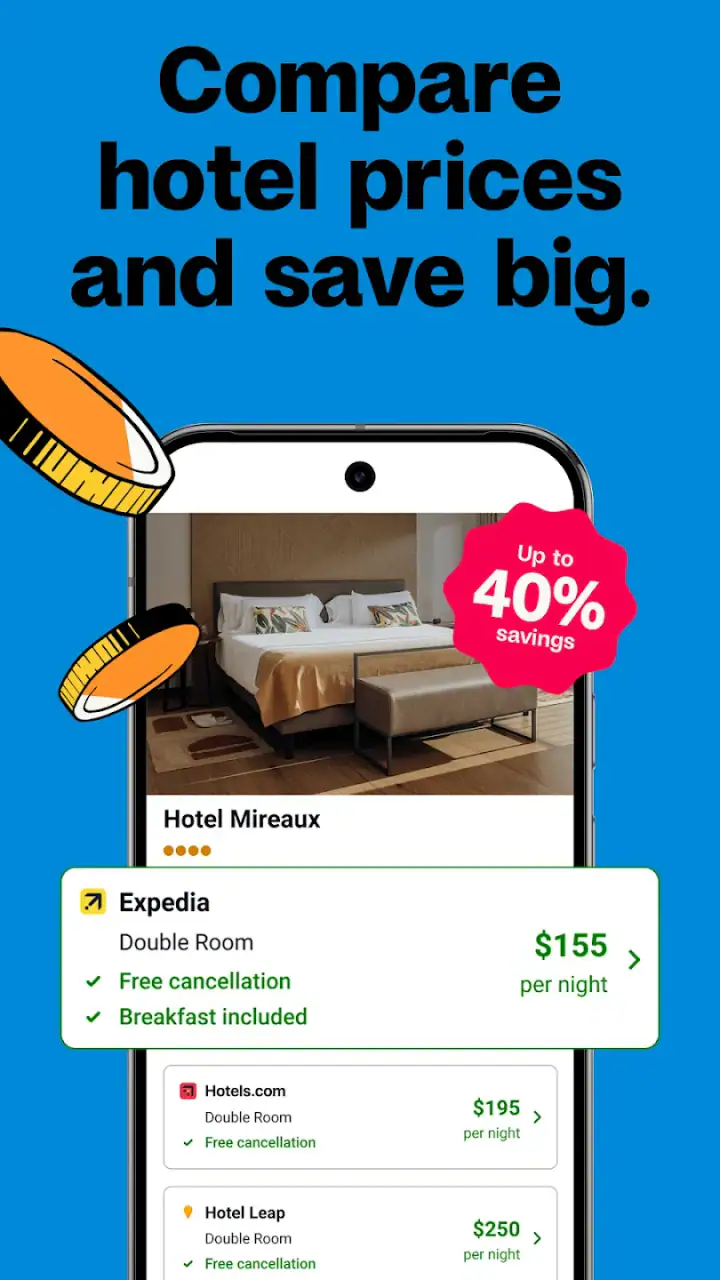
I also avoid judging accommodation by price alone. I compare the room description, the number of guests, the cancellation wording, and whether the offer appears to match the stay I entered. This is one of the less obvious strengths of using a comparison service: it encourages me to notice that “same hotel” does not always mean “same deal.” The app helps surface the alternatives, but my decision still depends on reading them properly.
Where it wins against opening booking sites one by one
The clearest advantage is reduced repetition. Without a comparison tool, I might search a hotel on several familiar sites, adjust the dates repeatedly, and keep notes about changing totals. Here, I can begin with a wider market view. That is valuable when I do not have loyalty to one booking provider or when I suspect that the first price I see is not the only available option.
Another advantage is decision confidence. Even when I eventually book through a familiar provider, seeing competing offers gives me a better sense of whether the choice is reasonable. I do not need to chase every tiny difference, but I can identify when a meaningful gap exists. For travelers who dislike the feeling of booking too quickly, that comparison step is reassuring.
The app also works well for flexible destination research. I can compare accommodation in different parts of a city or look at nearby areas before deciding where to stay. This is more practical than choosing a hotel first and discovering later that the location does not suit my plans. I often use the comparison stage to balance three things: nightly cost, distance from the places I want to visit, and the conditions attached to the offer.
Its popularity reflects that broad usefulness. The app has an average rating of 4.5 from around 363 thousand ratings, and it has passed 100 million installs. Those figures do not guarantee that every search will be perfect, but they do suggest that the comparison model is familiar and useful to a large audience. I see the strong adoption as a reason to try it, not as a substitute for checking the details of my own booking.
Three practical habits that make the comparison more useful
My first tip is to decide what “cheapest” means before searching. Sometimes I mean the lowest total, sometimes I mean the lowest refundable option, and sometimes I mean the best location within a fixed budget. If I do not define that beforehand, I can be distracted by a low figure that does not match my actual needs. The app is most helpful when I use it to compare like with like.
My second tip is to repeat a search after changing only one variable. I might keep the dates fixed and compare neighborhoods, then keep the neighborhood fixed and test different dates. This reveals which choice is driving the cost. It is a better method than changing everything at once, because I can understand the trade-off instead of merely seeing a different list of results.
My third tip is to take a screenshot or note the offer details before leaving the comparison screen, especially when I am researching on a mobile connection or expect to return later. I do not rely on memory for room names and conditions. When I continue to the booking provider, I compare the final page with what I intended to select. That small check helps prevent mistakes caused by tapping a similar-looking offer.
When Another Approach May Be Better
Direct hotel booking for a known property
If I already know the hotel, booking directly can be the cleaner route. The hotel’s own channel may present its room types and policies in a more focused way, and I do not need a comparison layer if I have already made the accommodation decision. In that situation, trivago still has value as a quick price check, but I would not use it as the only reason to change a booking plan.
A favorite booking site for repeat travelers
Some travelers prefer one booking provider because they already understand its interface, account history, or support process. If that familiarity saves time and the traveler is comfortable with the available offers, switching between comparison results and a preferred provider may feel unnecessary. I would use trivago when I want to challenge that default, particularly for an unfamiliar destination, but I would not insist on it for every routine booking.
Travelers who need a highly controlled booking process
For complicated trips, the comparison stage can add another layer to an already detailed process. A traveler booking several rooms, arranging special requirements, or coordinating a group may prefer to communicate directly with the accommodation or use a service built around that specific need. The app can help with research, but it is not a replacement for personal confirmation when an error would cause serious inconvenience.
There is also a trade-off for people who want an all-in-one travel organizer. This app is centered on accommodation comparison. If I want one place for transport, itineraries, tickets, and other trip tasks, I may still need additional apps or websites. That is not a flaw in the comparison itself, but it affects how many tools I need during a complete trip.
What switching to it really costs
The financial cost is low because the app is free, but the time cost depends on how carefully I compare. The first search can be fast, while a serious comparison may take longer because I am checking different providers and conditions. I consider that time worthwhile when the destination is expensive, the dates are flexible, or the cancellation terms matter. For a very simple booking, the extra inspection may not justify itself.
There is also a learning cost. I need to become comfortable distinguishing a property from an individual offer, and I need to remember that the booking process may continue outside the comparison experience. Once that workflow makes sense, it becomes fairly natural: search broadly, filter the practical choices, inspect the offer, then verify the final booking page.
The current version is 6.54.0, and the app has been available since December 3, 2010. I mention that because it feels like a mature comparison product rather than a brand-new experiment. Even so, I still keep my expectations realistic. A mature app can organize a large amount of information, but availability and pricing can change, and the best result for me may not be the first result shown.
A realistic everyday scenario
Imagine I am planning a three-night city break with a limited budget. I begin by searching the destination with my intended dates, then look at several areas instead of choosing the city center automatically. I notice that a slightly cheaper property farther out may require more transport time, while another offer at a similar price includes a cancellation condition that suits my uncertainty better.
I then compare the room details and guest count carefully. One result may look attractive until I realize it is for a different room configuration. Another may be more expensive at first glance but offer a condition I value more. I continue to the booking provider only after identifying the offer that matches my actual needs, and I check the final total and policy before confirming. In this scenario, the app does not make the decision for me; it makes the important differences easier to see.
Who should use it and who should skip it
I recommend it to independent travelers who compare prices before booking, people exploring an unfamiliar destination, and anyone who feels overwhelmed by checking multiple accommodation sites manually. It is particularly useful when I have some flexibility and want to understand how location, room type, and booking conditions affect the choice.
I would skip it as a primary tool if I already have a hotel and booking route I trust, if I need a very specialized arrangement that requires direct discussion, or if I dislike comparing several similar offers. It is also not ideal for someone expecting the app alone to manage every part of a trip. Its strength is focused: it helps me compare accommodation opportunities, not replace every travel service.
My recommendation after using it
My overall view is positive, with one important qualification: I recommend trivago as a research and comparison tool, not as permission to book without reading. It saves me from starting every trip with a scattered search across multiple sites, and it gives me a practical way to question the first price I encounter. The free access and broad accommodation coverage make it easy to keep in my travel toolkit.
I would begin with it when I am open to different hotels or booking providers, use the filters and area comparisons to narrow the decision, and then verify the final offer before paying. If the app helps me find a better match rather than merely a lower number, it has done its job. For that reason, I think it is a strong choice for comparison-minded travelers, while direct booking or a familiar provider may remain better for simple, highly specific, or already-decided reservations.
FAQs for trivago: Compare hotel prices
What is trivago and how does it work?
Trivago is a hotel search and price comparison app that aggregates deals from various booking sites to help users find the best rates. By entering your destination and travel dates, trivago compares prices from different platforms and displays them in a user-friendly interface, making it easy to choose the best option for your needs.
Is trivago free to use, and are there any hidden charges?
Yes, trivago is completely free to use. It does not charge any fees or add hidden costs to your bookings. The app merely redirects you to partner booking sites where the transactions occur. Ensure you check the final price on the booking site for any additional fees or taxes.
Can I book directly through trivago?
No, trivago does not facilitate direct bookings. Instead, it acts as a metasearch engine that redirects you to external booking sites. After selecting a hotel and comparing prices, you will be taken to the chosen booking platform to complete the reservation process.
Does trivago offer customer support for booking issues?
Trivago does not handle bookings directly, so it does not provide customer support for booking-related issues. Any queries or problems must be addressed with the booking site where the reservation was made. However, trivago does offer general support for using their app and website.
How accurate are the hotel ratings and reviews on trivago?
The hotel ratings and reviews shown on trivago are compiled from various booking sites and user feedback. While trivago strives for accuracy by aggregating this data, it is essential to cross-check reviews on the actual booking site for the most reliable information. User experiences can vary, so consider multiple reviews.
Pros
- User-friendly interface for easy navigation.
- Comprehensive hotel database worldwide.
- Efficient price comparison feature.
- Customizable search filters.
- No booking fees applied.
Cons
- Occasional slow loading times.
- Limited customer support options.
- In-app ads can be intrusive.
- Some listings lack detailed info.
- Requires internet for full functionality.


